
Class 5 Capitalization After Colon Grammar Worksheet

Class 5 Capitalization After Colon Grammar Worksheet
Command and Clarity: Capitalization After a Colon for Class 5
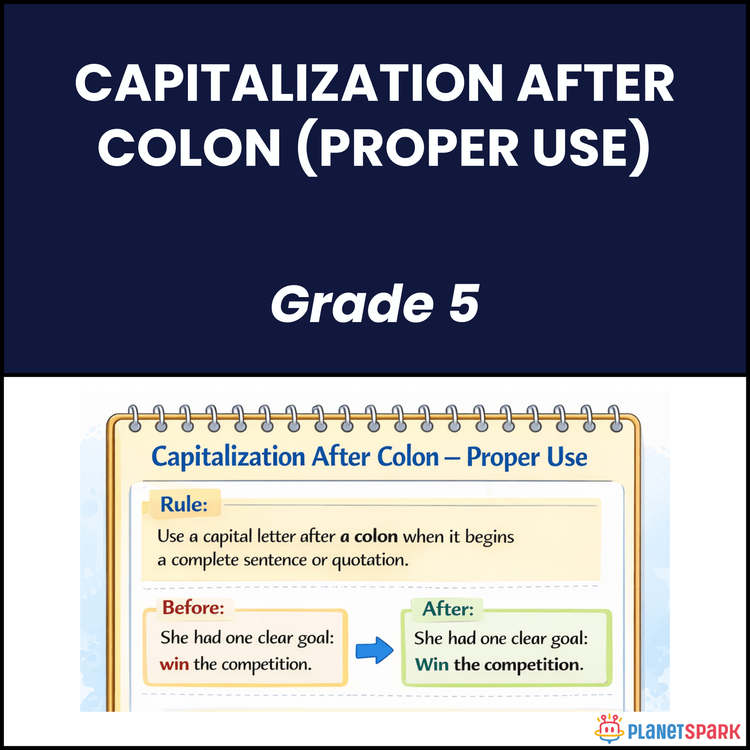
This Grade 5 grammar worksheet helps learners understand the correct use of capitalization after a colon in everyday sentences. Students explore how the first word after a colon should often begin with a capital letter when it introduces a complete sentence, instruction, announcement, or rule. Through structured practice and engaging activities, this worksheet builds clarity in punctuation and sentence structure.
Why Capitalization After a Colon Matters in Grammar?
Understanding capitalization after a colon helps students write clearer and more grammatically correct sentences. For Grade 5 learners, this concept is important because:
1. It teaches when the first word after a colon should begin with a capital letter.
2. It improves clarity in instructions, announcements, and quotes.
3. It strengthens punctuation awareness in both writing and reading.
4. It helps students follow proper grammar conventions used in formal English.
What’s Inside This Worksheet?
This worksheet includes five grammar-focused exercises designed to strengthen understanding of capitalization after a colon:
Exercise 1 – Multiple Choice
Students choose the sentence that uses correct capitalization after a colon. Each question presents three options, and learners must identify the correctly capitalized sentence.
Exercise 2 – True or False
Students read sentences and decide whether capitalization after the colon has been used correctly. This activity helps reinforce recognition of correct grammar usage.
Exercise 3 – Fill in the Blanks
Students complete each sentence with a suitable word. The key rule is that the first word after the colon must start with a capital letter.
Exercise 4 – Sentence Correction Using Word Bank
Students replace one word in each sentence with a word from the provided box. This helps improve sentence meaning while applying the capitalization rule correctly.
Exercise 5 – Paragraph Completion
Students read a short classroom passage and fill in missing words. This contextual activity helps learners apply capitalization rules within real writing situations.
Answer Key (For Parents & Educators)
Exercise 1 – Choose the Correct Sentence
1. Visit Delhi during the summer.
2. Open your notebooks now.
3. The bus will leave soon.
4. Run faster to the goal.
5. School will reopen on Monday.
6. Catch the ball quickly.
7. Save water every day.
8. Finish homework tonight.
9. Be ready by six today.
10. Work hard and stay kind.
Exercise 2 – True or False
1. True
2. True
3. False
4. False
5. False
6. False
7. False
8. True
9. True
10. True
Exercise 3 – Fill in the Blanks (Sample Correct Words)
1. Bring
2. Welcome
3. Stay
4. Save
5. Run
6. School
7. Catch
8. Be
9. Respect
10. Speak
Exercise 4 – Corrected Sentences
1. The teacher said: Write neatly today.
2. The guide said: Stay with the group.
3. The poster read: Save water every day.
4. The notice read: Bring your books tomorrow.
5. The coach said: Run faster now.
6. The captain said: Catch the ball quickly.
7. The message said: Bring your ID tomorrow.
8. The rule says: Save resources every day.
9. The teacher said: Read carefully today.
10. The sign read: Welcome to our school.
Exercise 5 – Paragraph Writing (Sample Answers)
1. Always
2. Welcome
3. Always
4. colon
Help your child write clearer and more polished sentences by mastering punctuation rules like capitalization after a colon with guided expert support at PlanetSpark.
Frequently Asked Questions
A colon is followed by a capital letter when it introduces a complete sentence or proper noun in formal English writing.
If the colon introduces a list or phrase rather than a full sentence, the next word usually stays lowercase in standard grammar rules.
It improves punctuation accuracy and helps learners write clearer sentences in CBSE English grammar worksheets.