
Class 7 Grammar Worksheet on Formal Informal Letters

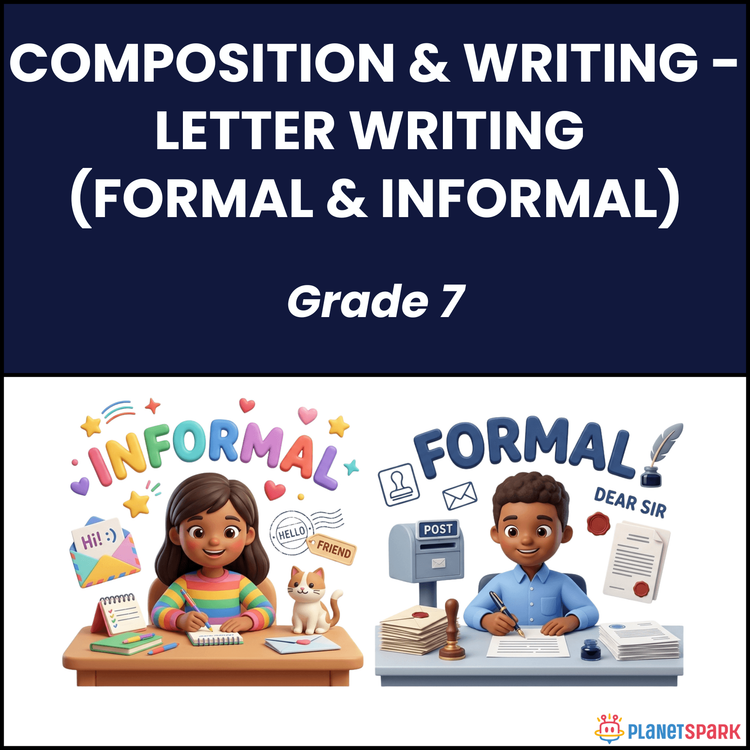
Class 7 Grammar Worksheet on Formal Informal Letters
Dear Commissioner, With Love to Grandma: Formal vs. Informal Letters for Grade 7
This Grade 7 worksheet teaches students the key differences between formal and informal letter writing using the charming story *The Postmaster of Malgudi*. Learners discover that formal letters (e.g., to a government official) require a respectful tone, a clear subject line, and a sign-off like “Yours faithfully,” while informal letters (e.g., to a grandmother) can be warm, casual, and end with “Your loving grandson.” Task types include multiple-choice questions (MCQs), fill-in-the-blanks, true/false statements, short answer questions, and a paragraph-writing activity comparing the two letter types. The worksheet builds essential real-world communication skills for school, exams, and personal writing.
Why Letter Writing Matters in Composition?
Letter writing teaches students to adapt their tone, structure, and vocabulary based on the audience and purpose. For Grade 7 learners, this topic is important because:
1. Formal letters appear in school applications, complaint letters, and future job correspondence.
2. Informal letters help maintain personal relationships through thoughtful, handwritten communication.
3. Understanding tone (respectful vs. casual) is a critical skill for all writing.
4. Letter writing reinforces proper salutations, closings, paragraph structure, and addressing conventions.
What’s Inside This Worksheet?
This worksheet includes five engaging activities built around the story *The Postmaster of Malgudi*:
🧠 Exercise 1 – Multiple Choice Questions (MCQs)
Students answer 10 comprehension questions about the story, testing their understanding of characters, settings, letter types, sign-offs, and key details.
✏️ Exercise 2 – Fill in the Blanks
Students complete 10 sentences by filling in missing keywords (e.g., dusty, banyan, morning, aerogrammes, troubled, subject line, gossip, clothes, bridges, desk).
✅ Exercise 3 – True and False
Students read 10 statements and mark them as true or false, correcting common misconceptions about formal and informal letters.
📝 Exercise 4 – Question & Answer
Students answer 10 short-answer questions that reinforce the key differences between formal and informal letters as shown in the story.
🎨 Exercise 5 – Paragraph Writing
Students write a short paragraph (50–70 words) explaining the differences between formal and informal letters based on the story.
✅ Answer Key (For Parents & Educators)
Exercise 1 – Multiple Choice Questions (MCQs)
1. b) Thirty years
2. a) Near a banyan (tree)
3. b) Malgudi town
4. a) Broken pipes
5. b) Commissioner
6. c) Mysore city
7. c) Faithfully (Yours faithfully)
8. a) Heavy monsoon
9. b) Penmanship
10. c) Voices/letters (the hopes and sorrows / voices of Malgudi)
Exercise 2 – Fill in the Blanks
1. Narayan worked in a dusty town.
2. His office sat near a banyan tree.
3. He sorted mail every morning.
4. He sorted mail including blue aerogrammes.
5. Arjun had a troubled look on him.
6. Formal mail needs a clear subject line.
7. A card can have local gossip.
8. Letters are like clothes for events.
9. Ink and paper are seen as bridges.
10. Narayan locked his wooden desk.
Exercise 3 – True and False
1. True
2. False (Arjun brought two envelopes, not three)
3. False (Narayan used a wooden desk, not metal)
4. True
5. False (The town of Malgudi is described as dusty, not clean and modern)
6. True
7. False (Arjun entered with a troubled look, not a happy one)
8. True
9. False (The monsoon arrived by evening, not in the morning)
10. True
Exercise 4 – Question & Answer
(Suggested answers based on the story)
1. What did Narayan sort every morning?
He sorted stacks of inland letters, postcards, and blue aerogrammes.
2. Why was the boy Arjun feeling troubled?
He was confused about how to correctly address the two letters he had.
3. What issue did the formal letter address?
Broken water pipes in his colony.
4. How did Narayan describe letter writing?
He said letters are like clothes — they must suit the occasion.
5. What was the card for the grandmother?
A colorful, hand-drawn card filled with casual stories and local gossip.
6. What was required for the formal letter?
A respectful tone, a clear subject line, and a formal sign-off like "Yours faithfully."
7. How did the postmaster feel about ink?
He felt that ink and paper created bridges of connection between people.
8. Where did people go to make phone calls?
The general store (where an occasional telephone call was available).
9. What did Narayan lock by the evening?
His wooden desk.
10. Where would the canvas bags travel to?
Across the plains of India.
Exercise 5 – Paragraph Writing (Sample Answer – 65 words)
Formal letters, like the one to the Municipal Commissioner, need a respectful tone, a clear subject line, and a sign-off like “Yours faithfully.” They address serious issues such as broken water pipes. Informal letters, like the card for Arjun’s grandmother, can be warm and casual. They may include local gossip and end lovingly, such as “Your loving grandson.” The audience and purpose decide the style.
Help your child master the art of letter writing for every occasion with a Free 1:1 Composition & Writing Trial Class at PlanetSpark.
Frequently Asked Questions
Formal letters use salutations like “Dear Sir/Madam,” full block format, formal closings (“Yours faithfully”), and no contractions; informal letters allow “Hi Mom,” shortened forms, and personal emotions.
Because CBSE English exams deduct marks for incorrect format; the sender’s address goes top right, date below left, recipient’s name and address on left before the salutation.
By giving the same situation (e.g., inviting a friend vs. inviting a chief guest) and asking students to rewrite it in formal and informal styles, changing word choice and sentence length.