
Class 7 Reading Comprehension Worksheet on Sequencing Events

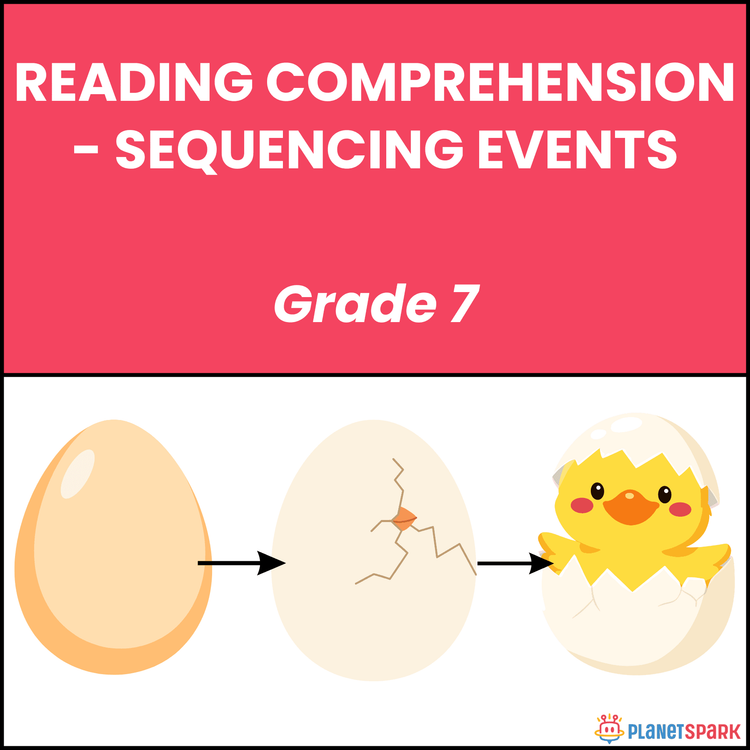
Class 7 Reading Comprehension Worksheet on Sequencing Events
Mastering the Timeline: Reading Comprehension and Sequencing Events for Class 7
This Grade 7 worksheet focuses on the essential literary skill of sequencing events to improve reading comprehension. Through the story "The Festival of the Dancing Fish," students learn to identify chronological order, recognize transition words, and understand the cause-and-effect relationship between narrative events. The worksheet includes diverse activities such as multiple-choice questions, word bank fill-in-the-blanks, true/false statements, and targeted underlining exercises
Why Sequencing Events Matters in Literature?
Sequencing events helps students build a logical framework for understanding complex narratives. For Grade 7 learners, this topic is important because:
1. It improves the ability to summarize stories accurately and coherently.
2. It helps identify key transition words like "first," "then," "after," and "finally."
3. It strengthens logical thinking by connecting actions to their specific outcomes.
4. It is a foundational skill for both reading comprehension and structured creative writing.
What’s Inside This Worksheet?
This worksheet includes five comprehensive activities that build mastery in chronological sequencing:
🧠 Exercise 1 – Multiple Choice Chronology
Students read the passage about Mangu the fisherman and choose the correct timing or order of specific events, such as when he pushes his boat or what he does after landing.
✏️ Exercise 2 – Word Bank Completion
Students use a word bank containing terms like "nylon," "brackish," and "shimmering" to complete sentences that describe the story's progression and setting.
📋 Exercise 3 – True or False Verification
Learners evaluate statements based on the text to confirm the accuracy of the event sequence, such as whether Mangu checked his nets before or after sunrise.
📝 Exercise 4 – Targeted Underlining
Students identify and underline specific transition words or phrases that signal time, such as "first," "immediately," or "finally," directly within the context of the story.
✅ Exercise 5 – Narrative Sequencing Summary
A final fill-in-the-blank exercise where students reconstruct the entire sequence of Mangu’s day to demonstrate a complete understanding of the narrative flow
✅ Answer Key (For Parents & Educators)
Exercise 1 – Multiple Choice Questions
1. a) Checked nets
2. b) Before sunrise
3. c) Middle of lagoon
4. c) Two hours
5. a) Hauled it in
6. b) To the shore
7. c) Went to market
8. a) Returned home
9. b) When he got home
10. a) Rice and a toy
Exercise 2 – Fill in the Blanks
1. nylon
2. previous
3. brackish
4. sunrise
5. shimmering
6. patiently
7. hauling
8. bargaining
9. returning
10. lagoon
Exercise 3 – True or False
1. False
2. True
3. False
4. False
5. True
6. False
7. True
8. False
9. True
10. False
Exercise 4 – Underlined Words/Phrases
1. The sun had not yet risen
2. First
3. 'Meena'
4. By sunrise
5. Then
6. Suddenly
7. securing the fish
8. immediately
9. Finally
10. bag of rice; small toy
Exercise 5 – Sequencing Summary
1. sequence
2. very
3. First
4. nets
5. previous
6. Then
7. boat
8. brackish
9. lagoon
10. After
11. jerk
12. Once
13. catch
14. shore
15. straight
16. bargaining
17. ends
18. moon
Empower your child to decode complex stories and master chronological flow with a Free 1:1 Communication Skills Trial Class at PlanetSpark.
Frequently Asked Questions
Sequencing events involves understanding and arranging the events of a story in the correct order.
It helps students understand the flow of the story and the cause-and-effect relationships between events.
Students can use graphic organizers like timelines or story maps to track events and their order.