
Class 6 Contextual Antonyms in Sentences Worksheet

Class 6 Contextual Antonyms in Sentences Worksheet
Opposites in Context: Contextual Antonyms in Sentences for Class 6
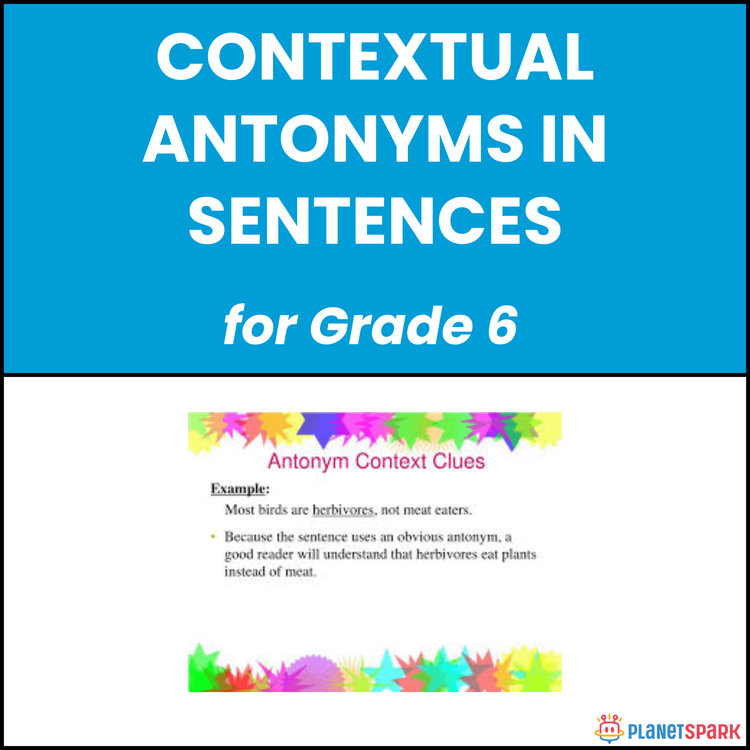
This Grade 6 worksheet helps students understand antonyms through sentence-based context. Learners practice identifying opposite meanings within real sentences, improving both comprehension and vocabulary skills.
Why Contextual Antonyms Matter in Grammar?
Learning antonyms through context helps students apply vocabulary correctly. For Grade 6 learners, this topic is important because:
1. It helps students understand opposites within real sentence usage.
2. It improves reading comprehension and meaning interpretation.
3. It strengthens vocabulary and word relationships.
4. It builds confidence in using correct words in writing and speaking.
What’s Inside This Worksheet?
This worksheet includes five structured exercises designed for step-by-step learning:
Exercise 1 – True or False
Students identify whether the given words in sentences are antonyms.
Exercise 2 – Sort the Words
Students sort word pairs into antonyms and not antonyms.
Exercise 3 – Fill in the Blanks
Students choose the correct antonym based on sentence context.
Exercise 4 – Multiple Choice Questions
Students select the correct antonym that fits the sentence.
Exercise 5 – Sentence Writing
Students write sentences using antonyms of given words.
Answer Key (For Parents & Educators)
Exercise 1 – True / False
1. True
2. True
3. True
4. True
5. True
6. True
7. False
8. False
9. False
10. True
Exercise 2 – Sort the Words
✅ Antonyms (Opposite Words)
increase – reduce
whisper – shout
dangerous – safe
accept – refuse
arrive – depart
expand – shrink
victory – defeat
light – heavy
forward – backward
kind – cruel
success – failure
❌ Not Antonyms (Similar / Related Words)
create – build
borrow – lend (related action, not opposites)
repair – fix
allow – permit
Exercise 3 – Fill in the Blanks
1. hot
2. wide
3. correct
4. full
5. strong
6. heavy
7. bright
8. difficult
9. quiet
10. long
Exercise 4 – Multiple Choice Answers
1. a) quiet
2. b) wide
3. d) correct
4. c) full
5. a) heavy
6. b) long
7. d) bright
8. b) hard
9. c) noisy
10. d) short
Exercise 5 – Sentence Writing (Sample Answers)
1. The classroom was quiet during the test.
2. The glass was full of water.
3. The man is strong and healthy.
4. The sky looked bright in the morning.
5. The story was long and interesting.
6. The bag felt heavy to carry.
7. The question was difficult to solve.
8. The child was noisy in class.
9. The road is wide and clear.
10. She arrived late to the meeting.
Help your child strengthen vocabulary and understanding of opposites with engaging context-based antonym practice.
Frequently Asked Questions
Contextual antonyms are words that have opposite meanings based on how they are used in a sentence, helping students understand contrast in context.
Context ensures students choose the correct opposite word, as meanings can change depending on the sentence.
Students can read sentences carefully, identify meaning clues, and select antonyms that best match the context.